Your Monument Shop Is One Lost Order Away From Disaster (And You Know It)
I've spent the last two years talking to monument shop owners. Over 200 conversations. From small family operations in rural towns to larger dealers serving multiple counties.
And I keep hearing the same thing, said different ways:
"I wake up at 3 AM wondering if I forgot something."
"Everything's in my head and I'm terrified of what happens if I'm not here."
"One of these days, something's going to slip through the cracks."
They're right to be worried.
Because in this business, one mistake doesn't just cost you money. It costs you trust. And in the monument industry—where families are grieving, emotions are raw, and word travels fast—trust is everything.
Let me tell you about an email that cost one dealer $4,000 and a customer they'll never get back.
The $4,000 Email That Changed Everything
A monument dealer I spoke with—we'll call him Tom—had just finalized a beautiful custom granite memorial. The family had chosen a deep black granite with delicate floral engraving. The design was approved. The deposit was paid. The work was already underway in the shop.
Then Tom's phone pinged.
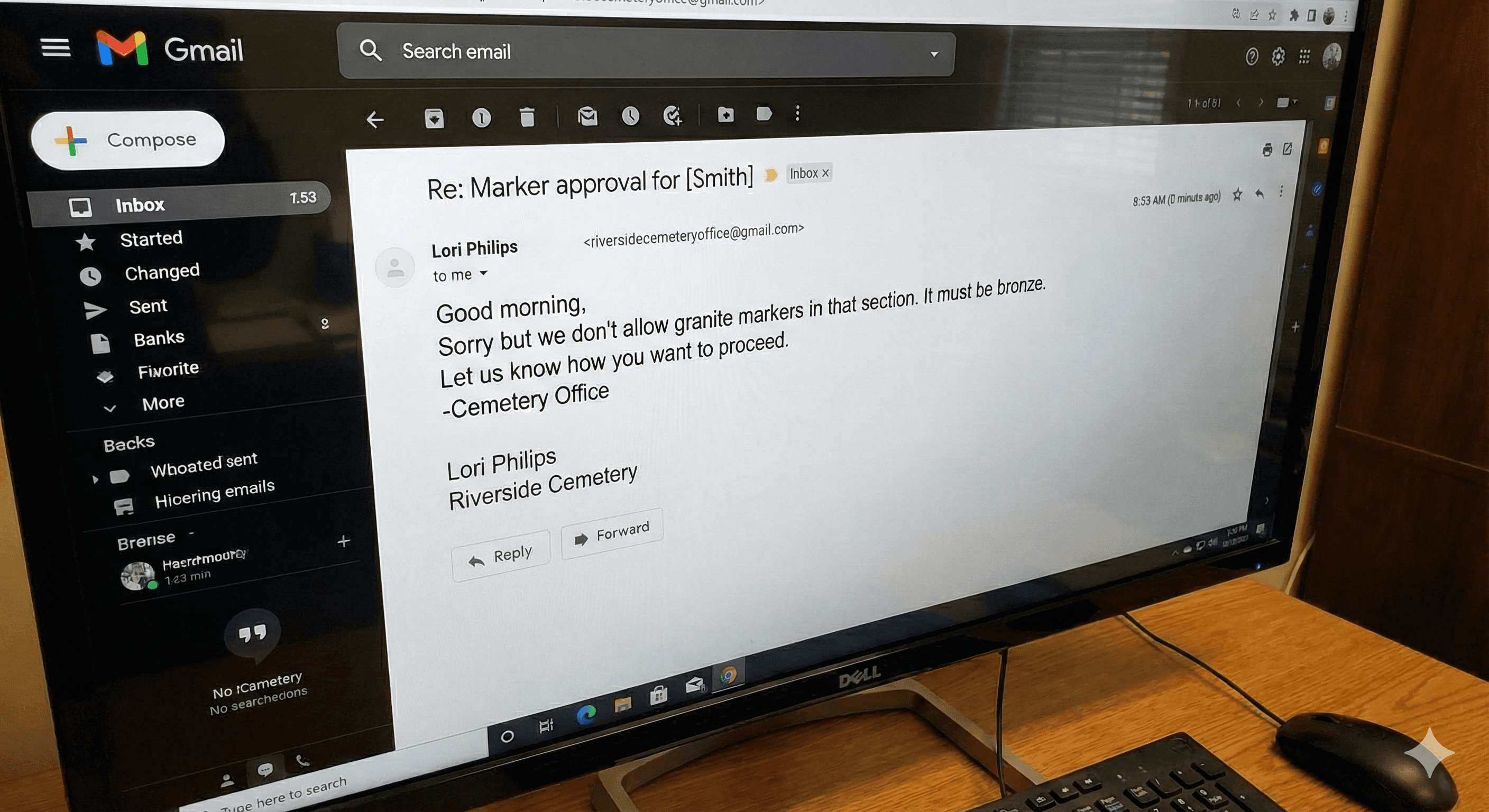
An email from the cemetery: "Please be advised that [Cemetery Name] only permits bronze markers in Section C where this memorial is designated. No granite installations will be approved."
Tom read it twice. Then checked the paperwork. The cemetery name was right there. The section was right there. But nowhere in his notes did it say "bronze only."
The "oh shit" moment: Tom realized the work order never included a cemetery rules check. His sales team had assumed granite was fine—because it usually is. The family had assumed the dealer knew the rules—because why wouldn't they?
Nobody verified. And now they had a $4,000 custom granite memorial that couldn't be installed.
What Happened Next Was Worse
Tom called the family to explain. They were confused. Then frustrated. Then angry.
"You're telling me we waited six weeks for something you can't even use?"
Tom offered to remake it in bronze at no additional charge. But the damage was done. The family had lost confidence. They'd already been anxious about the process—this was their mother's memorial, after all. Now they questioned everything: Could they trust the new design? Would there be other mistakes? What else didn't this dealer know?
Two weeks later, Tom got a call from a competitor asking for the family's deposit refund paperwork. The family had moved on.
Tom didn't just lose $4,000 in materials and labor. He lost:
A customer who would have referred others
A relationship with the funeral home that sent the referral
His team's confidence (they felt terrible)
Sleep for the next month
And here's the thing that keeps me up at night: this story isn't unique.
This Happens More Often Than Anyone Admits
Of the 200+ monument shop owners and managers I've spoken with over the past two years, I'd estimate 60-70% have had a significant order mistake in the past 12 months.
Not small stuff. I mean disasters:
Lost paperwork. One dealer found a contract for a veteran's memorial six months after the family ordered it—wedged behind a filing cabinet. The family had already called twice. They went with someone else.
Wrong cemetery. A shop carved a family name correctly but installed it in the wrong cemetery plot. They didn't realize until the funeral director called, confused about why the memorial was in Section D when the burial was in Section F.
Mixed-up families. Two orders for families with similar last names (both "Johnson"). One wanted a traditional cross design, the other wanted a modern flat marker. Guess what got switched during production.
Expired permits. A memorial sat finished in the shop for eight weeks because nobody followed up on the cemetery foundation permit. By the time they called, the permit had expired and they had to start the approval process over. The family thought the dealer was incompetent.
These aren't "whoops" moments. These are reputation-ending mistakes.
And the worst part? Every single dealer I talked to knew it could happen to them.
The Real Cost of "Just One Mistake"
Let's be honest about what a lost order actually costs:
The Obvious Cost: Money
Materials wasted: $1,500 - $4,000 depending on granite type and size
Labor hours: 10-20 hours of skilled engraving work that can't be reused
Rework costs: Starting over from scratch, often on a rush timeline
The Hidden Cost: Reputation
Lost referrals. That family won't recommend you. That's 2-3 potential future orders gone.
Funeral home relationships. Funeral directors stop sending families your way if they hear complaints.
Online reviews. One angry family writes a detailed Google review. Every future prospect reads it.
Staff morale. Your best engraver feels terrible. Your salesperson questions everything. Team confidence drops.
The Personal Cost: Peace of Mind
You can't take a vacation because "what if something gets missed?"
You wake up at 3 AM mentally checking if you followed up on that cemetery permit
You work Saturdays catching up on paperwork instead of spending time with family
You snap at your spouse because the anxiety is constant
One dealer told me: "I'm 58 years old. I've been doing this for 30 years. I should be winding down, not lying awake wondering if I forgot to call back the Anderson family."
That's not a business. That's a prison.
Why This Keeps Happening (And Why It's Not Your Fault)
Here's what I've learned after all these conversations: Monument shop owners aren't incompetent. Their systems are.
The way most shops operate today was built for a different era:
Fewer orders per month
Simpler designs
Less demanding families
Fewer cemetery regulations
But the business has changed:
Today's monument shops handle 2-3x more orders than they did 20 years ago. Families expect text updates and real-time communication. Every cemetery has different rules—and those rules change. Custom designs are more complex. Compliance requirements are stricter.
Meanwhile, most dealers are still using:
Paper order forms that get lost
Whiteboards that get erased
Mental notes about cemetery rules
Spreadsheets that crash
File folders that live in someone's truck
It's not a people problem. It's a systems problem.
And here's the brutal truth: if your system is "I'll remember" or "it's on a sticky note" or "everything's in my head"—you're not running a business that can scale. You're running a business that's one lost order away from disaster.
The Wake-Up Call You Already Know Is Coming
Let me ask you something, and be honest:
How many orders are in your shop right now?
Now ask yourself:
Can you instantly tell me the status of each one?
Do you know which cemeteries have special requirements?
Has every family been updated this week?
Are all your cemetery permits current?
If you got sick tomorrow, could your team find everything?
If you hesitated on any of those questions, you already know the answer.
You're not in control. You're in survival mode. And survival mode works—until it doesn't.
The dealer who lost that $4,000 granite order? He told me: "I knew our system was a mess. I kept telling myself I'd fix it next month. And then next month came and I was too busy. Then that email arrived."
That email is coming for you too. The only question is when.
What Actually Prevents Disasters
After hearing the same stories over and over, I started asking a different question: "What do the dealers who DON'T lose orders do differently?"
And here's what I found: They stopped trusting their memory and started trusting their system.
The dealers who sleep well at night have three things in common:
1. Every order lives in one searchable place Not scattered across notebooks, whiteboards, and filing cabinets. One central system where everything about every order is instantly accessible.
2. Cemetery rules are checked automatically, not manually They don't rely on someone remembering that Oak Hill only allows bronze or that Riverside has size restrictions. The system flags it before work begins.
3. Nothing depends on one person's brain If the owner is on vacation or an employee calls in sick, the business doesn't stop. The system knows what happens next.
This isn't theory. This is what's working right now for monument dealers who've made the switch.
How Monudesk Prevents The $4,000 Email
This is exactly why we built Monudesk.
After working with hundreds of monument dealers through my work with RememberTag and Monudesk, I kept hearing the same nightmare stories. The lost orders. The cemetery rejections. The families who lost trust.
Monudesk is monument shop software designed to make disasters impossible.
Here's how it works:
Every Order, Tracked Automatically No more lost paperwork. Every order, every detail, every conversation lives in one central system. If a family calls asking about their memorial, you pull it up in 3 seconds—not 20 minutes of hunting through file cabinets.
Cemetery Rules, Checked Before You Start Work Here's the game-changer: our Pro plan (available July 2026) includes AI-powered cemetery rule checking. Upload a cemetery's rulebook once. Our system learns it. Then, every time you create an order, Monudesk automatically checks if your material choice is allowed.
Selecting granite for Oak Hill Cemetery Section C (bronze only)? The system flags it before you start fabrication.
No more $4,000 emails. No more panicked phone calls. No more families going to competitors.
Family Communication, Handled Automatically Families get their own secure portal with automatic updates. They stop calling you three times a week because they can check progress themselves. You stop being the bottleneck.
Team Workflow, Always Clear Your engraver knows exactly which orders to work on next. Your installer knows which foundations are ready. Your salesperson knows which families need follow-up. Nobody has to ask you what happens next.
The ROI Is Brutally Simple
Monudesk Pro costs $300/month.
One prevented mistake pays for the entire year.
That $4,000 granite memorial that couldn't be installed? If Monudesk's cemetery rule checker had flagged it before fabrication started, that disaster never happens.
But it's not just about money. It's about:
Sleeping through the night because you know nothing's falling through the cracks
Taking a vacation without your phone ringing every two hours
Growing your business without hiring more people to manage the chaos
Protecting your reputation so families keep choosing you and referring others
One dealer who switched told me: "I didn't realize how much stress I was carrying until it was gone. I haven't lost an order since we started using Monudesk. That alone is worth ten times what we pay."
The Choice You're Already Making
Here's the reality: you're going to invest in something.
Either you invest in a system that prevents disasters—or you keep investing in fixing them after they happen.
The math is simple:
One lost $4,000 order = 13+ months of Monudesk Pro
One family who goes to a competitor = 2-3 future referrals gone
One damaged funeral home relationship = dozens of potential orders lost
One sleepless night wondering if you forgot something = priceless
You already know your current system isn't sustainable. You've known for a while.
The question is: what happens before you fix it?
Do you fix it now, while you're in control? Or do you wait for that email—the one that says you fabricated the wrong material, or missed the permit deadline, or lost the paperwork for a family who's now filing a complaint?
What To Do Next
If you're tired of operating one lost order away from disaster, here's what I recommend:
Start with a reality check. Look at your current system honestly. How many places do you have to check to find order information? How many times this month has someone asked "where are we on the [Family Name] memorial?" and nobody knew immediately?
See how Monudesk prevents disasters. Schedule a 30-minute demo and we'll show you exactly how the system prevents lost orders, checks cemetery rules automatically, and gives you back peace of mind.
Try it risk-free. We offer a 14-day trial because we know once you see your orders centralized, your team moving faster, and your stress dropping—you won't want to go back to sticky notes and hope.
The Dealers Who Wait vs. The Dealers Who Act
I've talked to enough monument shop owners to know there are two types:
Type 1 says "I know I need to fix this, but I'm too busy right now. I'll deal with it next quarter." They keep running on survival mode until something breaks. Then they're scrambling to rebuild trust, replace lost revenue, and repair their reputation.
Type 2 says "I'm tired of being one mistake away from disaster. I'm fixing this now." They invest in systems that prevent problems instead of just reacting to them. They sleep better. They grow faster. They actually enjoy running their business again.
Which type are you?
The $4,000 email is coming. Maybe not today. Maybe not this week.
But it's coming.
The only question is whether you'll be ready.
Schedule Your Monudesk Demo →
See exactly how monument shops are eliminating lost orders, preventing cemetery mistakes, and finally getting control of their business.
I'm [Your Name], and I've spent the last two years working with monument dealers through RememberTag and Monudesk. After 200+ conversations, I've heard every nightmare story—and I've seen what works. If you're ready to stop living one lost order away from disaster, let's talk.